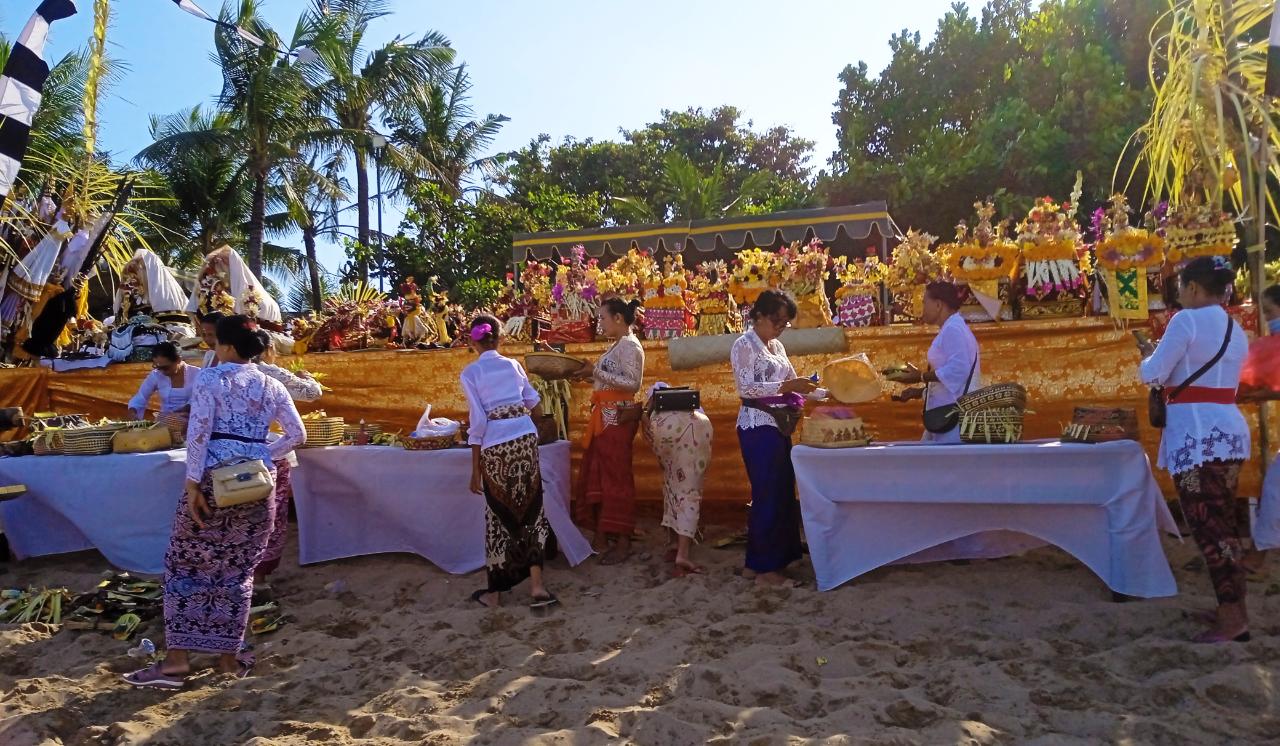
Balinese ceremonies are elaborate and vibrant cultural events that are an essential part of Balinese Hinduism. These ceremonies revolve around the worship of the gods and ancestors, seeking blessings, and purification.
Table of Contents
Galungan: Celebrating Good Over Evil
The most significant of these ceremonies are Galungan and Kuningan, which celebrate the triumph of good over evil. Galungan is a ten-day festival that commences with the victory of Indra over the demon king Mayadanawa. Celebrations include offerings of fruit and flowers, elaborate temple processions, and traditional Kecak and Legong dances. The distinctive tall bamboo poles decorated with yellow coconut leaves — known as penjor — line the streets of every village, marking the occasion with visual splendour. Galungan is one of the most visually striking of all Balinese ceremonies and transforms every street and compound on the island.
Kuningan: Honouring the Ancestors
Kuningan is the final day of the Galungan festival, where blessings are given to the ancestors to thank them for their guidance and protection. The Balinese hold these celebrations every 210 days, meaning Galungan and Kuningan together occur twice a year and are marked as official public holidays in Bali. Families return to their home villages, rituals are performed across the island, and the atmosphere is one of collective joy and reverence.
Nyepi: Bali’s Sacred Day of Silence
Another significant ceremony is Nyepi or the Day of Silence, which falls on the lunar calendar new year. On Nyepi day, Balinese Hindus observe a complete day of silence and contemplation. Streets are empty, all activities halt, and the airport closes. No electricity, noise, or travel is permitted. The night before, the Ogoh-Ogoh parade — featuring enormous demon effigies — fills the streets with fire and energy before the island falls into total stillness at midnight. Nyepi is one of the most extraordinary of all Balinese ceremonies: a day when an entire island stops entirely.
Other Balinese Ceremonies Worth Knowing
Other ceremonies include Piodalan, which celebrates a village temple’s anniversary or birthday; Odalan, which is similar to Piodalan but is celebrated for an individual or a family temple; and Galungan Pepasahan ceremony, which celebrates knowledge and wisdom. These smaller-scale Balinese ceremonies may not attract international attention, but they are often more intimate and moving for visitors who happen to encounter them during their stay.
These ceremonies are more than religious events. They reflect the Balinese culture’s vibrancy, emphasizing social cohesion, and a strong sense of community. They provide an opportunity for families and friends to come together to celebrate, offer thanks to the gods, and seek blessings for the future. In this way, Balinese ceremonies serve as the heartbeat of the island — visible in every temple procession, every offering, and every prayer whispered quietly before dawn in the family temple.


How Balinese Ceremonies Enrich the Visitor Experience
For visitors to Bali, witnessing these Balinese ceremonies is often a defining moment of their trip. Respectful observation is always welcome, and many tour operators can time visits to coincide with a local ceremony. Arriving early, dressing modestly in a sarong, and remaining quiet during rituals are simple courtesies that are deeply appreciated. These events are living traditions, not performances — and approaching them with genuine curiosity and respect enriches both the visitor experience and the community’s ability to maintain their sacred practices. For more on Bali’s spiritual culture, explore our guides to Bali traditional villages, Canang Sari, and the best Bali villa areas. For background on Balinese Hinduism, see Balinese Hinduism on Wikipedia.
<< If you liked this article, you may also like our other articles >>
To chat with our marketing partner about your business, please contact The Travellist